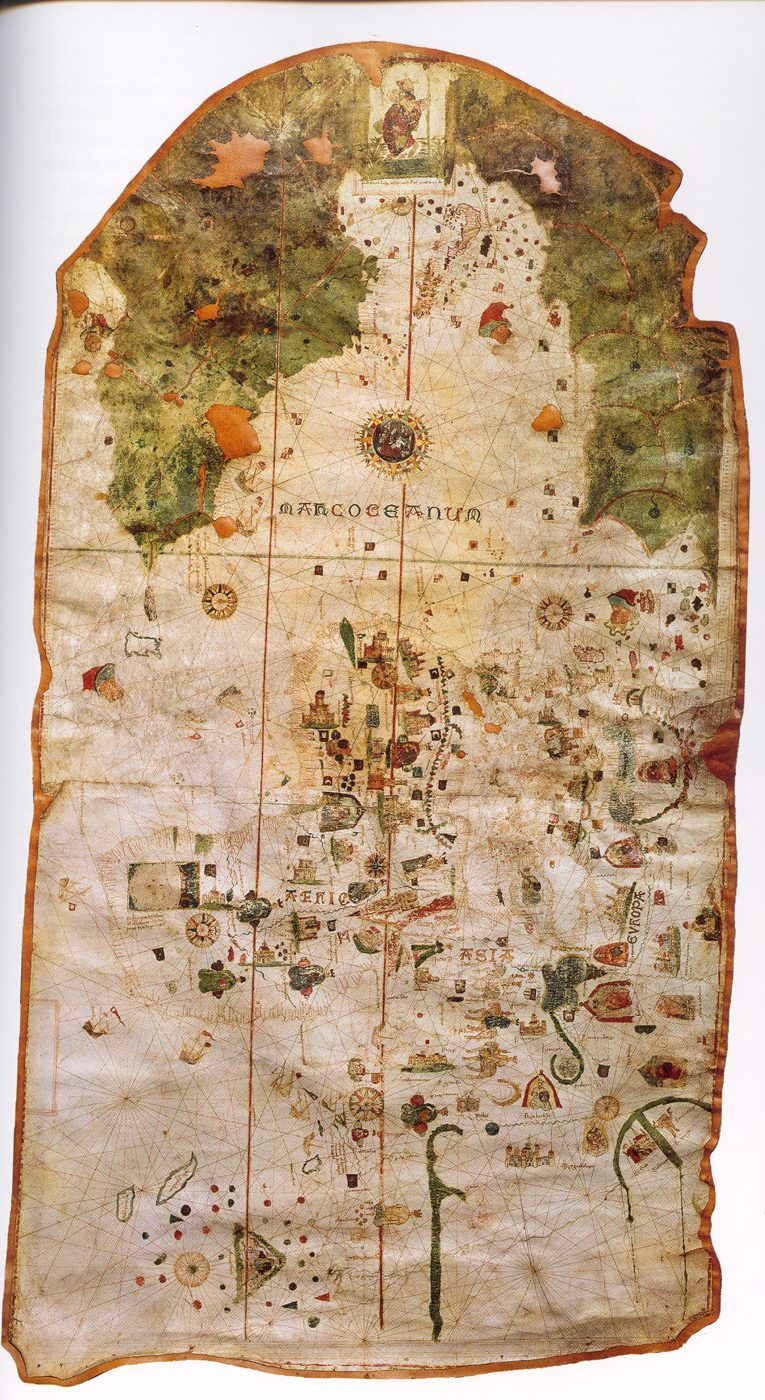
World chart by Juan de la Cosa, 1500.Juan de la Cosa · Public domain · Wikimedia Commons
A bigger fleet
In 1493 Columbus sailed again, this time with a much larger fleet: 17 ships and more than 1,200 men.
On the north coast of Hispaniola, his settlers built a town called La Isabela, with houses, storerooms, a church and a large house for Columbus. In March 1494, his men began searching the island's mountains for gold, guided by Taíno. They found only small amounts.
A letter home
One of the men on this voyage was Michele de Cuneo, a nobleman from Savona, near Genoa, said to have been a childhood friend of Columbus. In 1495 he wrote a long letter home describing the voyage.
Cuneo described, matter-of-factly, robbery, kidnapping and sexual violence carried out by the men under Columbus's command. He also described capturing an Indigenous woman whom, he wrote, the Admiral gave to him, and then sexually assaulting her.
As recently as the early 1960s, Samuel Eliot Morison, one of the leading American historians of his day, introduced Cuneo's letter by calling him "a jolly dog" who liked to have a good time.
That tells us something about the voyage, and something about how the story was told for centuries afterward.
▶ Evidence Locker
Three Witnesses
1 of 3
Michele de Cuneo, letter, 1495
A nobleman on the second voyage describes robbery, kidnapping and sexual violence by Columbus's men, including his own assault on a captive woman the Admiral gave him.
War with dogs
On March 24, 1495, Columbus marched against the caciques of the island with about 200 soldiers, 20 horses and 20 attack dogs. His ally was Guacanagarí, the cacique who had rescued the Santa María's cargo.
More than 1,500 Taíno were captured to be shipped to Spain and sold. Columbus sent about 500 Taíno to the slave market in Seville.
The tribute
Columbus then demanded gold. Every Taíno aged 14 and older living near the gold mines had to deliver gold as tribute. The quota was enough gold dust to fill a small hawk's bell every three months.
There was never much gold on Hispaniola. The quota could not be met.
In his own words
In 1500, Columbus wrote a letter to Doña Juana de la Torre, who had been a nurse at the royal court. In it he described a trade in Indigenous women and girls on the island. Dealers, he wrote, were going about looking for girls, and girls of nine or ten were now in demand.
Columbus was complaining about the conduct of other settlers, not about himself. But this was the colony he governed.
▶ Evidence Locker
Three Witnesses
2 of 3
Columbus, letter to Doña Juana de la Torre, 1500
Columbus describes dealers looking for girls on the island, with girls of nine or ten in demand.
The Queen steps in
On June 20, 1500, Queen Isabella ordered that the Indigenous people Columbus had sent to Andalusia to be sold were to be freed and returned to the Indies.
Complaints about Columbus's rule had been reaching Spain for some time, from his own settlers. They said he made them work with barely a mouthful to eat, and that he put down revolts with the same brutality he had shown the Indigenous people.
The monarchs sent an investigator, Francisco de Bobadilla.
The inquiry
When Bobadilla arrived at Santo Domingo in 1500, he found that Columbus had hanged five Spaniards. He took statements from 23 witnesses.
They described a government without trials. A man caught stealing grain had his nose and ears cut off and was sold as a slave. A woman who said publicly that Columbus came from a low-status family, the son of a weaver, was paraded naked on a mount, and on the order of Columbus's brother Bartholomew her tongue was cut out. Witnesses also said the Columbus brothers forbade the baptism of Indigenous people, so that they could still be used as slaves.
Some witnesses were Columbus's enemies. Others were close to him, and even they described abuses.
Francisco de Bobadilla — imagined illustrationAI-generated artwork, not a historical portrait or verified likeness. His appearance and the setting are imagined.
▶ Interactive
The Inquiry of 1500
Santo Domingo, Hispaniola, 1500. Complaints about the Admiral's rule have reached Queen Isabella and King Ferdinand. They have sent you, Francisco de Bobadilla, to find out what is happening in their colony.
Hear the witnesses. Read the Admiral's own defense. Weigh each account. Then decide what the Crown's investigator should do.
Folio 1 of 7 · Royal order
The Queen's command
Queen Isabella has issued an order, dated June 20, 1500: the Indigenous people Columbus had sent to Andalusia to be sold as slaves are to be freed and handed to you, to be returned to the Indies.
How does this order shape your inquiry?
Folio 2 of 7 · Finding on arrival
The gallows
When you land at Santo Domingo, you learn that Columbus has hanged Spaniards from his own colony.
Folio 3 of 7 · Witness testimony
The stolen grain
Witnesses describe a man caught stealing grain. His nose and ears were cut off; he was chained and sold as a slave.
Folio 4 of 7 · Witness testimony
The woman who spoke
A woman said publicly that the Admiral came from a family of low status, the son of a weaver. On his brother Bartholomew's order she was paraded naked on a mount and her tongue was cut out. Witnesses say Columbus praised his brother for defending the family's honor.
Folio 5 of 7 · Complaints from settlers
Work without food
Settlers complain that they were made to work with barely a mouthful to eat, and that revolts were put down with the same brutality the Admiral had shown the Indigenous people.
Folio 6 of 7 · Witness testimony
No baptism
Witnesses say the Columbus brothers forbade the baptism of Indigenous people, so that they could still be used as slaves.
Folio 7 of 7 · The Admiral's defense
Columbus answers
In a letter to Doña Juana de la Torre, a lady of the court, Columbus defends himself. He calls himself God's messenger to a new world. He says he should not be judged like the governor of a peaceful Spanish city, but like a captain who conquered a warlike people in a land with no towns or courts. And he says his work has made Spain rich.
Does his defense answer the charges?
Testimony is paraphrased from reports on the inquiry record, not quoted. Some witnesses were Columbus's enemies; others were close to him, and even they described abuses.
23 witnesses describe hangings, mutilations and a government without trials.
In chains
Bobadilla had Columbus's brother Diego arrested, seized the Admiral's papers and took control of Santo Domingo. Columbus gave himself up. He was put in irons and sent back to Spain in chains, with his brothers.
In Spain, the monarchs restored his titles and honors. Bobadilla was recalled. But Hispaniola now had a new governor, Nicolás de Ovando.
For five centuries, the record of Bobadilla's inquiry was lost. Then the archivist Isabel Aguirre found it in Spain's General Archive of Simancas. The historian Consuelo Varela published it in 2006.
These accusations were not invented by modern critics. They were collected in 1500, by an official sent by the same king and queen who had paid for the voyages.
▶ Interactive
Myth or Fact?
1. Columbus's conduct was only criticized by modern historians.
2. In 1500, Queen Isabella ordered that Indigenous people Columbus had sent to Spain for sale be freed and returned.
3. Columbus was sent back to Spain in chains in 1500.
4. The record of Bobadilla's inquiry has been public for centuries.
5. Hispaniola was rich in gold.
▶ Interactive
The Ledger
Entry
Record
Ships on the second voyage
17
Men
More than 1,200
Gold found in the mountains, 1494
Small amounts
Taíno captured, 1495
More than 1,500
Taíno sent to the Seville slave market
About 500
Spaniards hanged by Columbus
Five
Final entry
The Admiral sent home in chains
When the gold did not come, what did the colony trade in instead?
Haiti
Ayiti Connection
Haiti and the Dominican Republic were then one island under one colonial government. The war of 1495, the gold tribute and the slave raids fell on the whole island, including Guacanagarí's people in what is now northern Haiti.
▶ Chapter 4
Hero Meter
After the inquiry of 1500, how much does Columbus deserve the title of hero?
1105
Badge locked
Investigator
Sources
1.Columbus, the Indians, and Human Progress, from Howard Zinn's A People's History of the United States (libcom): second voyage of 17 ships and more than 1,200 men
2.La Isabela (Wikipedia): the town's buildings; March 1494 search for gold; March 24, 1495, campaign with Guacanagarí, 200 men, 20 horses, 20 hounds
3.What Celebrating Columbus Says About Us (Robert S. McElvaine): Cuneo's 1495 letter and its contents; Morison's "jolly dog" introduction
4.The American natural world described by Michele de Cuneo, 1495 (Teresa Nobre de Carvalho, Universidade Nova de Lisboa): Cuneo's letter to Gerolamo Aimari
5.'First-hand' tale of Columbus voyage (Learn Antiques): Cuneo said to have been a childhood friend of Columbus
6.Taíno genocide (Wikipedia): more than 1,500 Taíno captured to be sold in Spain; gold tribute from those 14 and older near the mines
7.The Lost Mariner, by Elizabeth Kolbert, The New Yorker, 2002 (excerpt at Bunk History): about 500 Taíno sent to the Seville slave market; hawk's bell of gold dust every three months; little gold on Hispaniola
8.Columbus sex slaves (Snopes): Columbus's 1500 letter to Juana de la Torre
9.Putting Columbus in context (Acton Institute): the letter complains about other settlers' conduct
10.Pedro de Torres (Hispanopedia): royal order of June 20, 1500, freeing the captives
11.Francisco de Bobadilla (Britannica): five Spaniards hanged; Diego arrested; Columbus in irons; titles restored; Bobadilla recalled
12.Columbus exposed as iron-fisted tyrant (Transcend Media Service): 23 witnesses; archivist Isabel Aguirre; Simancas; Varela; the woman's punishment; baptism forbidden; witnesses friendly and hostile
13.Report on the Bobadilla document (Hayadan): the grain thief; the woman's punishment; 23 witnesses
14.Columbus exposed as cruel tyrant (History News Network): Varela on a tyrannical government without trials; even his friends described atrocities
15.When the Catholic Monarchs ordered Columbus's arrest (El Debate, 2024): settlers' complaints of hunger and brutal punishment of revolts
16.Oviedo on Columbus and his brothers sent to Spain in chains (Vassar: Oviedo on Columbus and his brothers sent to Spain in chains (Vassar)
17.Anacaona (Wikipedia): Nicolás de Ovando as governor of the island
18.En Bas Saline, Haiti (Florida Museum of Natural History): Guacanagarí's probable town in northern Haiti
Ask the case file
Question about this lesson?
Answers come only from this lesson's text. If the text doesn't cover it, you'll be told.
AI-powered. Always check answers against the chapter and its sources.