Lesson 6
Other Sails, and the Middle Passage
1498–1804
The race to Asia
While Columbus searched the Caribbean for Asia, Portugal kept sailing the other way. On May 20, 1498, the Portuguese captain Vasco da Gama reached Calicut, in India, by sailing around Africa. The sea route to Asia had been found, and it did not run west.
▶ Interactive
Race to Asia
Vasco da Gama
Christopher Columbus
That August, on his third voyage, Columbus entered the Gulf of Paria, off today's Venezuela. At first he thought the land was an island. After exploring the waters of the Orinoco River, he concluded he had found another continent. He suggested it might lie near the Garden of Eden.
A continent named for someone else
A Florentine merchant named Amerigo Vespucci sailed along the coast of South America on voyages around 1499–1500 and 1501–1502. Printed letters under his name told Europeans that these lands were not Asia at all, but a New World.
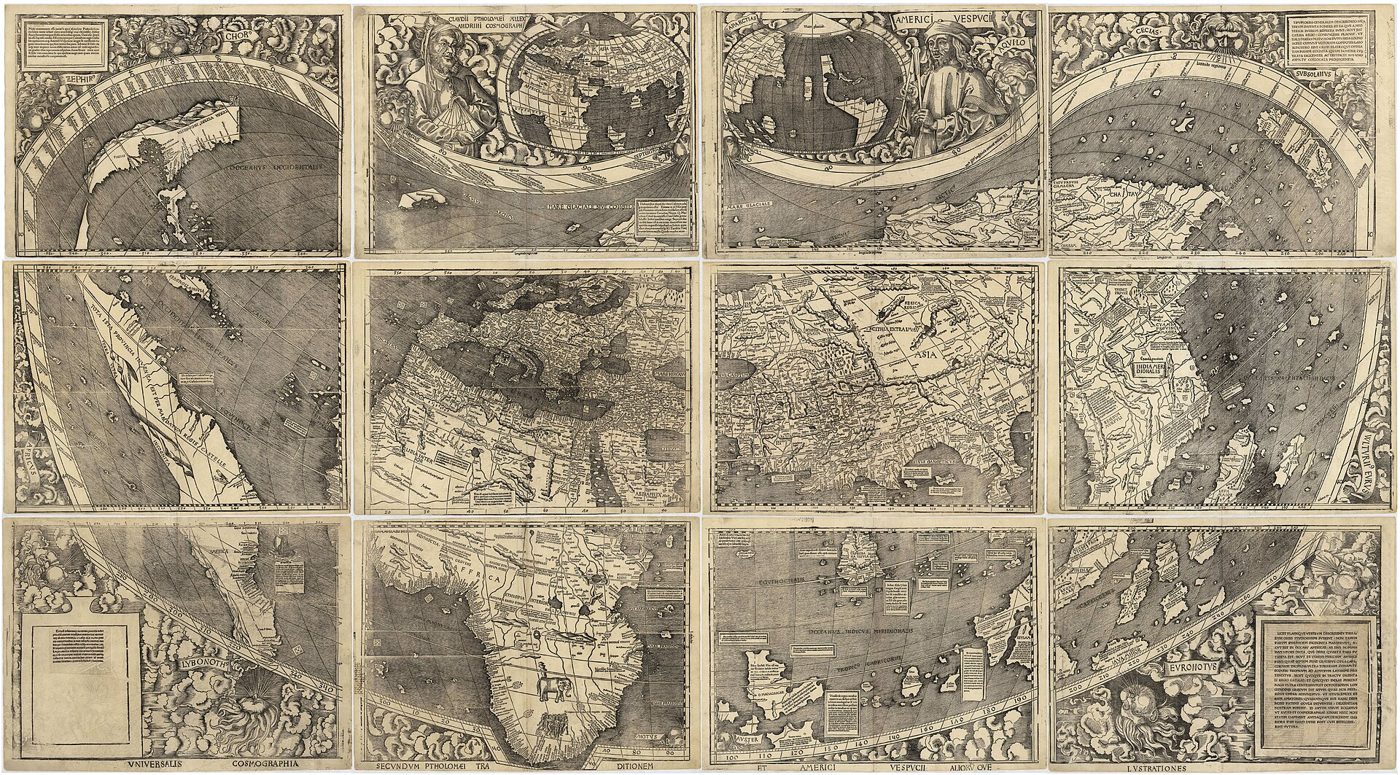
In 1507, the mapmakers Martin Waldseemüller and Matthias Ringmann, working at Saint-Dié in Lorraine, printed a world map. On the southern continent they wrote the name "America," from the Latin form of Vespucci's first name.
Marooned
On his fourth voyage, Columbus ended up stranded on the island of Jamaica. When the local people stopped bringing food, he consulted an astronomical almanac that predicted a total eclipse of the moon on February 29, 1504. He told the chief that his God was angry, and would darken the rising full moon as a sign.
The eclipse came on schedule.
▶ Interactive
The Eclipse
Jamaica, February 29, 1504. You lead the local people. The stranded strangers want more food. Their leader says that tonight his God will darken the rising full moon if you refuse.
Columbus returned to Spain and spent his last years trying, without success, to win an audience with King Ferdinand to press his claims. He died in Valladolid on May 20, 1506, a disappointed man.
Replacing the Taíno
The story did not end with Columbus.
The first enslaved Africans arrived on Hispaniola in 1501, brought as household slaves by the entourage of the new governor, Nicolás de Ovando. As the Taíno population collapsed and gold ran short, colonists turned to sugar, and demanded more enslaved Africans to grow it. By 1520, more than 2,000 had arrived.
Remember the proposal from Chapter 5: Bartolomé de las Casas, trying to spare the Taíno, suggested bringing Africans instead. He later changed his mind after seeing what slavery did to them.
The first revolt
On December 26, 1521, enslaved Africans rose up on a sugar estate near Santo Domingo. The estate belonged to the island's governor, Diego Colón, Columbus's own son. Many of the rebels were Wolof, from West Africa.
It is the earliest recorded slave revolt in the Americas. Diego Colón crushed it. On January 6, 1522, he issued what are believed to be the first laws in the Americas written to control enslaved Africans.
Read that again. The first recorded revolt of enslaved Africans in the Americas broke out on the estate of Christopher Columbus's son.
The scale
Between 1501 and 1867, slave ships carried about 12.5 million captives out of Africa. About 10.7 million survived to land in the Americas.
▶ Interactive
The Ledger closes
The final account of Columbus's four voyages.
| Promised in 1492 | Delivered |
|---|---|
| A western sea route to Asia | None. Da Gama reached Asia by sailing east |
| Gold | Little; the tribute could not be met (Chapter 4) |
| New lands for Spain | Islands of the Caribbean and a continent, later named for Amerigo Vespucci |
| A profitable colony | A colony whose governor was sent home in chains (Chapter 4) |
The account did not close with Columbus. Between 1501 and 1867, about 12.5 million Africans were carried onto slave ships. About 10.7 million survived the crossing.
Full circle
In 1697, Spain accepted French control of the western third of Hispaniola. The French colony there, Saint-Domingue, became the richest French colony in the West Indies. By the 1780s it produced about 40 percent of Europe's sugar and 60 percent of its coffee. Between 1681 and 1791, an estimated 790,000 to 860,000 enslaved Africans were brought there.
In late August 1791, the enslaved people of the northern plains rose up. On January 1, 1804, Jean-Jacques Dessalines proclaimed independence and gave the nation the island's Taíno name: Haiti. It became the first independent Black nation in the Western Hemisphere.
Haiti
Ayiti Connection
The island where Columbus's flagship was wrecked, where the Taíno were forced to pay tribute in gold, and where the first recorded revolt of enslaved Africans broke out, is the island where enslaved people later won their freedom and founded a nation.
▶ Chapter 6
Hero Meter
After seeing where this story led, how much does Columbus deserve the title of hero? (1–10, saved for Chapter 8.)
Badge locked
Cartographer
Sources
- 1.Vasco da Gama: Round Africa to India (Fordham Internet History Sourcebook): reached Calicut on May 20, 1498
- 2.Columbus lands in South America (History.com): Gulf of Paria, August 1498; after exploring the Orinoco, he concluded it was another continent
- 3.Christopher Columbus dies (History.com): Garden of Eden; failed attempts to see King Ferdinand; died in Valladolid on May 20, 1506, a disappointed man
- 4.Vespucci and the Map That Named America (World History Encyclopedia): Vespucci's voyages; the New World letters; Waldseemüller and Ringmann's 1507 map at Saint-Dié
- 5.How a lunar eclipse saved Columbus (Live Science): February 29, 1504; Regiomontanus's almanac; what Columbus told the chief
- 6.America's first black slave rebellion turns 500 years (Dominican Today): first enslaved Africans in 1501 with Ovando's entourage; shift from gold to sugar; the 1521 revolt on Diego Colón's estate; Wolof (Gelofe) rebels
- 7.The first rebellion of enslaved Africans in America turns 500 (La Estrella de Panamá): more than 2,000 enslaved Africans arrived by 1520
- 8.Bartolomé de Las Casas (New World Encyclopedia): his proposal and later change of mind
- 9.The 1521 Santo Domingo Slave Revolt (BlackPast): earliest recorded slave revolt in the Americas; crushed by Diego Colón; laws of January 6, 1522
- 10.Voyages: The Trans-Atlantic Slave Trade Database (Wikipedia): about 12.5 million embarked, 1501–1867; about 10.7 million landed
- 11.Saint-Domingue (Wikipedia): Spain's 1697 acceptance of French control; richest French colony in the West Indies; sugar and coffee shares; 790,000–860,000 enslaved people brought 1681–1791
- 12.The August 1791 slave revolt (John Carter Brown Library, Brown University): uprising in the northern plains in late August 1791
- 13.Haiti (Wikipedia): Dessalines proclaimed independence on January 1, 1804, reviving the Taíno name
- 14.Independence of Haiti (Wikipedia): first independent Black nation in the Western Hemisphere
- 15.Trump issues a Columbus Day proclamation (NPR via OPB): after 1492, Columbus made three more voyages, four in all
Ask the case file
Question about this lesson?
Answers come only from this lesson's text. If the text doesn't cover it, you'll be told.
AI-powered. Always check answers against the chapter and its sources.
Loading saved progress…