Lesson 1
The Salesman
1476–1492
A weaver's son
The man we call Christopher Columbus never used that name. He was born in Genoa, a busy port city in what is now Italy, in 1451. In Italian his name was Cristoforo Colombo. In Spain he became Cristóbal Colón. "Christopher Columbus" is the Latin form, Christophorus Columbus, later carried into English.
His father, Domenico Colombo, was a weaver who also dealt in wool. Over the years Domenico also worked as a cheesemaker, a tavern keeper and a wine dealer. His son chose the sea.
▶ Interactive
Name Game
Match each name to its language.
Tap a name, then tap its language.
Fire at sea
On August 13, 1476, a French fleet attacked the convoy Columbus was sailing with off the coast of Portugal. His ship caught fire. He jumped overboard and reached land, though the ship had been about six miles from shore. He then made his way to Lisbon.
The idea
Columbus proposed a different route: sail west across the Atlantic, and you will reach Asia from the other side.
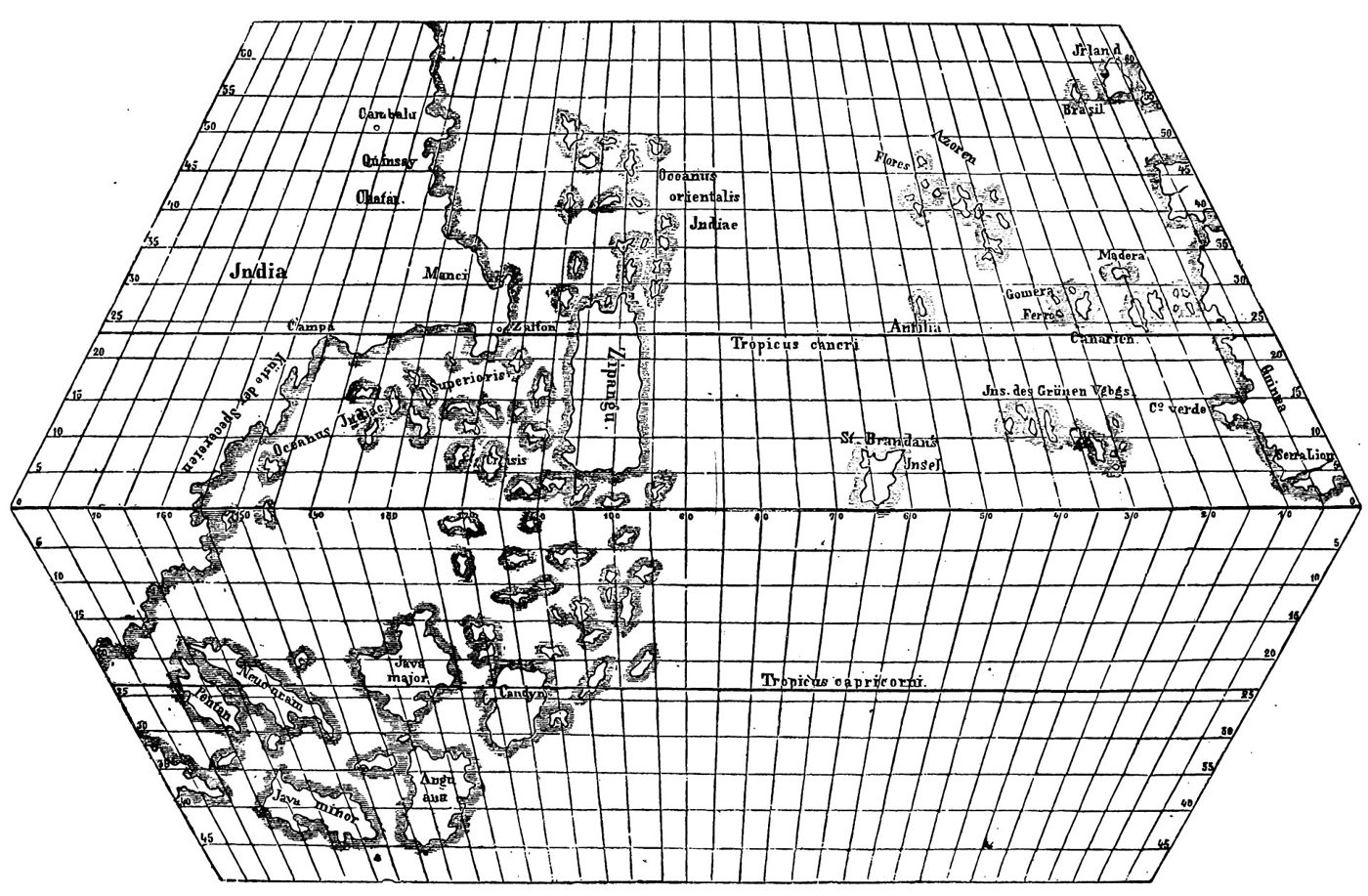
Educated Europeans of the time already knew the earth was round. The question was how far Asia lay to the west. Columbus relied on the ideas of a Florentine scholar, Paolo dal Pozzo Toscanelli, and on small estimates of the earth's size. He also mixed up different units of measurement. By his math, Japan lay about 2,500 nautical miles west of the Canary Islands.
The real distance is more than 10,000 nautical miles. Columbus was not slightly off. He was off by a factor of four.
The answer from Portugal
In 1484, Columbus presented his plan to King João II of Portugal. The king sent it to a commission of experts. They recommended rejecting it.
The experts did not think the earth was flat. They thought the ocean was too wide: ships would run out of food and water long before reaching Asia. They also judged the voyage too expensive. They called his idea vain, "simply founded on imagination."
▶ You Decide
The Pitch Room
Lisbon, 1484. You sit on King João II's commission of experts. A Genoese sailor stands before you. He says Japan lies only about 2,500 nautical miles west of the Canary Islands, close enough to reach by ship. What do you recommend?
Six years of waiting
Columbus took his plan to Spain. Around 1486, Queen Isabella of Castile asked Hernando de Talavera to set up a commission to study it. The commission met on and off for years. In 1490, it too recommended against the plan.
His brother Bartholomew tried England, setting out for the court of King Henry VII. Pirates captured him on the way.
Stop here for a moment. Two panels of experts, in two kingdoms, had studied Columbus's numbers and said no. They were right. Columbus had no new evidence. What he had was persistence, and timing.
The last kingdom falls
Ferdinand and Isabella had been at war with the Emirate of Granada, the last Muslim-ruled kingdom in Spain. On January 2, 1492, its ruler, known as Boabdil, surrendered. The war was over.
The monarchs had camped through the siege at Santa Fe, a fortified town built outside Granada. There, on April 17, 1492, they signed an agreement with Columbus, overriding their own experts.
The deal
The agreement, called the Capitulations of Santa Fe, gave Columbus everything he asked for. He would be Admiral of the Ocean Sea, viceroy and governor-general of any lands he found, with the honorific "don." He would also receive one tenth of all the riches the voyage produced.
The money came together in pieces. Luis de Santángel, a royal treasurer, had persuaded Isabella to accept the plan. He arranged most of the funding without interest, partly from his own pocket and partly with borrowed money; the Crown repaid him later. The town of Palos owed the Crown a debt and paid it by providing two of the ships. Italian financiers covered part of the cost.
The famous story that Isabella sold her jewels to pay for the voyage is a myth.
▶ Interactive
Myth or Fact?
1. In 1492, educated Europeans believed the earth was flat.
2. Columbus was Spanish.
3. Portugal's experts rejected Columbus because they feared ships would fall off the edge of the world.
4. Queen Isabella sold her jewels to pay for the voyage.
5. Columbus was promised one tenth of all the riches his voyage produced.
6. The town of Palos provided two of the ships to pay a debt it owed the Crown.
▶ The Ledger
The Ledger opens
The Ledger follows the money through the book. Chapter 1 opens the account.
| Entry | Record |
|---|---|
| Ships | 3; two provided by Palos to settle a debt to the Crown |
| Funding | Mostly arranged by Luis de Santángel without interest, later repaid by the Crown; part paid by Italian financiers |
| Promised to Columbus | Admiral of the Ocean Sea, viceroy, governor-general, and one tenth of all riches |
| Promised to the Crown | A western sea route to Asia |
| Columbus's distance to Japan | About 2,500 nautical miles |
| Real distance to East Asia | More than 10,000 nautical miles |
Two expert panels said no. If you were the monarchs, would you sign?
Haiti
Ayiti Connection
While Columbus was knocking on royal doors, the island the Taíno called Haiti was home to organized societies led by caciques. Around 1474, in Yaguana, today's Léogâne in Haiti, a girl named Anacaona was born. She grew up to be an acclaimed poet and composer whose works were performed at areítos, Taíno ceremonies of song and dance. She will return in Chapter 5.
▶ Chapter 1
Hero Meter
Based on this chapter alone, how much does Columbus deserve the title of hero?
Badge locked
Royal Auditor
Earned by finishing the Pitch Room and Myth or Fact.
Sources
- 1.Christopher Columbus (Wikipedia): name in Latin, Italian and Spanish; born in Genoa in 1451; Bartholomew sent to Henry VII's court, captured by pirates
- 2.Domenico Colombo (Wikipedia): weaver and wool dealer; also cheesemaker, tavern keeper, wine dealer
- 3.Years in Portugal (BYU Religious Studies Center): attack of August 13, 1476; swam ashore and reached Lisbon; 1484 pitch to João II; commission's reasons for rejecting the plan
- 4.Map of the World According to Christopher Columbus c. 1490 (World History Encyclopedia): Toscanelli; small estimates and mixed-up units; 2,500 nautical miles vs. more than 10,000
- 5.Hernando de Talavera (Wikipedia): commission set up around 1486; recommended against in 1490; overridden in 1492
- 6.Granada War (Wikipedia): Boabdil surrendered Granada on January 2, 1492
- 7.Capitulations of Santa Fe (Wikipedia): signed April 17, 1492, at the Santa Fe siege camp; titles and one tenth of riches
- 8.Luis de Santángel (Wikipedia): persuaded Isabella; arranged most of the funding without interest; repaid by the Crown
- 9.Christopher Columbus: Five things you thought you knew (Christian Science Monitor): jewel story a myth; Palos supplied two ships to settle a debt; Italian financiers
- 10.Anacaona (Wikipedia): born about 1474 in Yaguana (Léogâne, Haiti); acclaimed composer and poet; works performed at areítos
- 11.A History of the Life and Voyages of Christopher Columbus (Wikipedia): Irving's 1828 book spread the flat-earth myth; educated medieval thinkers knew the earth was round
Ask the case file
Question about this lesson?
Answers come only from this lesson's text. If the text doesn't cover it, you'll be told.
AI-powered. Always check answers against the chapter and its sources.
Loading saved progress…