Lesson 2
Lost at Sea
August–November 1492
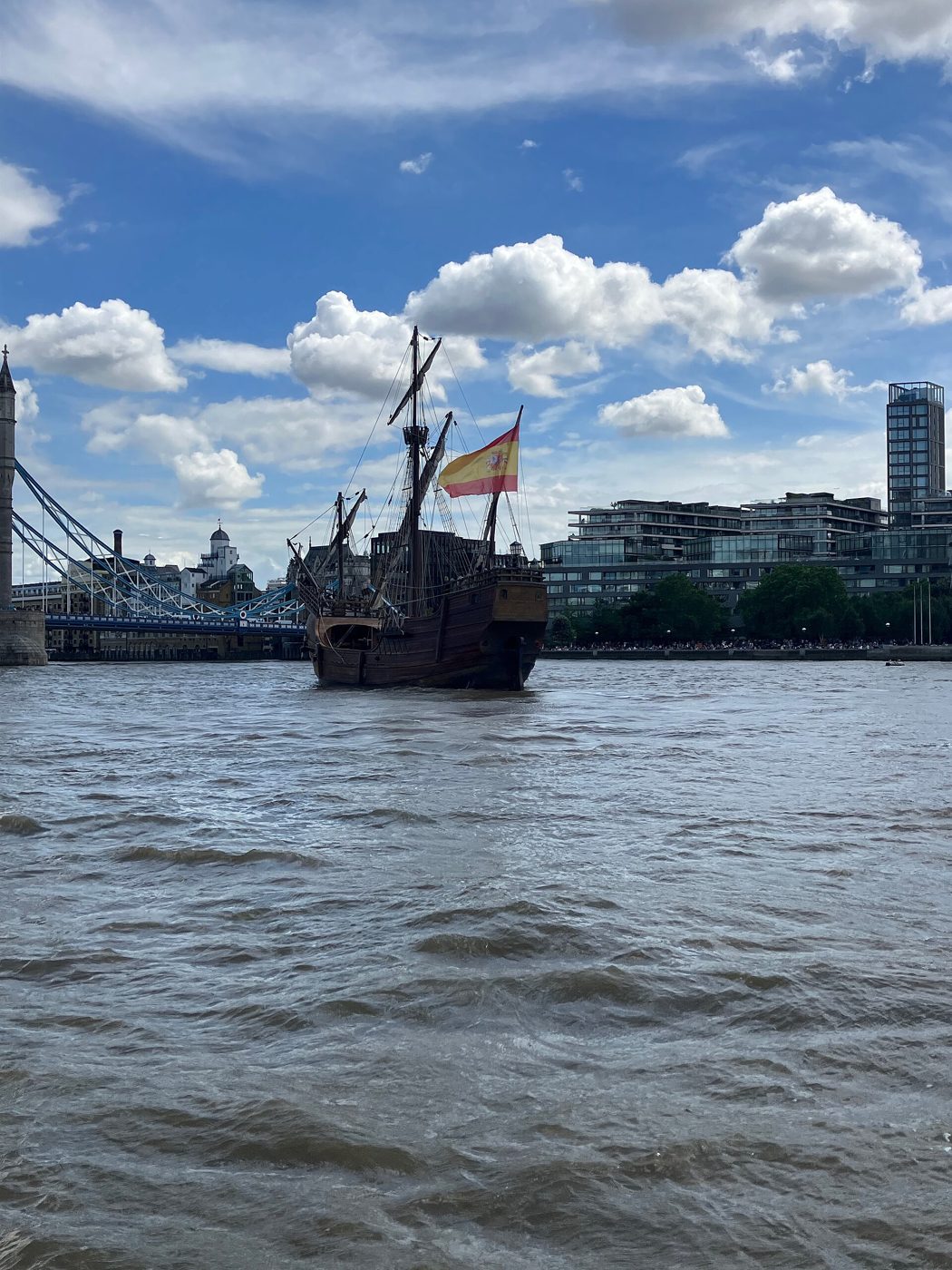
Three ships, ninety men
On August 3, 1492, three ships left the port of Palos de la Frontera in southern Spain: the Niña, the Pinta and the Santa María. About ninety men sailed with them.
They stopped at the Canary Islands to restock and make repairs, then left the island of La Gomera on September 6, heading west into open ocean.
Two sets of numbers
Columbus kept an accurate record of how far they had sailed, but told the men a smaller number. On September 10, he recorded 180 miles and announced 144.
On September 25 he did it again, recording about 65 miles and telling the crew 39. To the men on deck, home seemed closer than it really was.
Land
Before they sailed, Ferdinand and Isabella had promised a reward of 10,000 maravedís to whoever first sighted land.
At about 2 a.m. on October 12, 1492, a lookout on the Pinta named Rodrigo de Triana spotted land.
Columbus claimed the reward for himself. He wrote that four hours earlier he had seen a light "like a little wax candle rising and falling," though he admitted it was too faint to call it land. He found witnesses to back his claim.
▶ You Decide
The Lookout's Reward
You are Rodrigo de Triana, lookout on the Pinta. At about 2 a.m. on October 12, you see land and shout the news. The monarchs promised 10,000 maravedís to the first person to sight land. Now the Admiral says he saw a light hours before you did. What do you do?
Guanahaní
The land was a small island in what is now the Bahamas. Its Lucayan people called it Guanahaní. Columbus renamed it San Salvador.
No one is certain which modern island it was. It is traditionally identified with the island now called San Salvador, but scholars still debate it.
What he wrote
Columbus kept a journal of the voyage. In the entry for October 11, written as he first met the islanders, he described them as intelligent and wrote that they would make good servants and could easily be made Christians.
Three days later, on October 14, he wrote that with fifty men they could all be subjugated and made to do whatever was wanted.
Read those dates again. Within three days of meeting these people, Columbus was already writing about how few soldiers it would take to rule them.
▶ Evidence Locker
The Journal
Unlock two entries from Columbus's own journal. Read the plain-English summary of each, then answer the question.
Where did he think he was?
Columbus believed he had reached the edge of Asia, the region Europeans called the Indies. In his journal, he calls the people he met "Indians."
On October 28 he reached Cuba, which he named Juana, and explored its northeastern coast until December 5. He believed Cuba was mainland China. Two years later, on his second voyage, he had a notary record a statement, signed by his crew, that Cuba was part of the Asian mainland.
In fact, Japan was still thousands of miles away, across an entire continent and the Pacific Ocean. His estimate of the distance from the Canary Islands to Japan was about 2,500 nautical miles. The real westward distance is more than 10,000.
▶ Interactive
Map Quest
Not placed
Not placed
Columbus's own math put Japan roughly 2,500 nautical miles west of the Canary Islands; the real distance westward to East Asia is over 10,000 nautical miles. Distances are straight-line (great-circle) figures. Guanahaní is placed at San Salvador Island, its traditional identification; scholars still debate which island it was. Source: World History Encyclopedia, 'Map of the World According to Christopher Columbus c. 1490'.
The Pinta goes its own way
On the night of November 21, off the coast of Cuba, the Pinta, captained by Martín Alonso Pinzón, separated from the other two ships. It would not rejoin Columbus for about six weeks.
▶ Interactive
Myth or Fact?
1. Columbus was the first person on the expedition to sight land.
2. Columbus told his crew they had sailed shorter distances than they really had.
3. We know exactly which island Guanahaní was.
4. Columbus believed Cuba was part of Asia.
5. On his 1492 voyage, Columbus landed in what is now the United States.
▶ Interactive
The Ledger
| Entry | Record |
|---|---|
| Days at sea from La Gomera to Guanahaní | 36 (September 6 to October 12) |
| Asia reached | No |
| Reward for first sighting land | Claimed by Columbus, not the lookout who saw it |
| Ships still with Columbus on November 22 | 2 of 3; the Pinta had gone its own way |
The voyage has found islands, not Asia. Is it a success so far?
Haiti
Ayiti Connection
The Lucayans of Guanahaní were the first people of the Americas to meet Columbus. Less than two months later, on December 6, 1492, his two remaining ships reached the island the Taíno called Haiti. What happened there is the subject of Chapter 3.
▶ Chapter 2
Hero Meter
After the first landfall, how much does Columbus deserve the title of hero?
Badge locked
Navigator
Sources
- 1.Columbus sets sail (National Geographic Education): August 3, 1492, from Palos; three ships; about 90 men
- 2.Excerpts from the log of Christopher Columbus (Delaware Department of Education): true and announced distances on September 10 and 25; reward of 10,000 maravedís; Rodrigo de Triana named
- 3.Rodrigo de Triana (Wikipedia): lookout on the Pinta; Columbus's claim of a light four hours earlier; his witnesses
- 4.Guanahani (Wikipedia): Lucayan name of the landfall island; renamed San Salvador; identification debated
- 5.Journal of Christopher Columbus, 1492 (American Yawp): October 11 and 14 entries
- 6.Christopher Columbus dies (History.com): he believed the Caribbean was Asia and Cuba was mainland China
- 7.The Letter of Columbus on the Discovery of America (Internet Archive): landed on Cuba, named Juana; explored its northeast coast until December 5
- 8.Cristóbal Colón (Pueblos Originarios): June 14, 1494, notarized statement signed by the crew that Cuba was mainland
- 9.Map of the World According to Christopher Columbus c. 1490 (World History Encyclopedia): 2,500 vs. more than 10,000 nautical miles
- 10.Diego de Arana (Wikipedia): the Pinta separated off Cuba on November 21; rejoined about six weeks later
- 11.Môle Saint-Nicolas (Britannica): arrival on Haiti, December 6, 1492
- 12.Christopher Columbus (Wikipedia): Canary Islands stop; left La Gomera September 6; land sighted about 2 a.m. October 12; reached Cuba October 28
- 13.Trump issues a Columbus Day proclamation (NPR via OPB): Columbus never made it to what is now the U.S.
Ask the case file
Question about this lesson?
Answers come only from this lesson's text. If the text doesn't cover it, you'll be told.
AI-powered. Always check answers against the chapter and its sources.
Loading saved progress…